Pokazywanie postów oznaczonych etykietą stretching psychology. Pokaż wszystkie posty

niedziela, 3 września 2017

How to enjoy the stretching?


(wersja polska - TUTAJ)

"The brain likes what it likes"


What does it mean?
It simply means that we will either consciously or unconsciously always strive for the activities, things, and so on and on that we really like, which make us happy, which give us pleasure, and those we treat as an "enemy" will be avoided - such activities will cause mental and physical pain.


What impact does it have on your stretching sessions?


Many people associate stretching with pain, with something very necessary, but unpleasant, which in turn tightens the muscles by sending stimuli to the brain blocking the unwanted activity.
When a person who stretches has a negative attitude to the stretching, what happens is:

• she or he is afraid of the pain,
• she or he dislikes this action

The person can forget about any long-lasting, long-term positive effects.


It will also be very difficult for a person to maintain regularity in training sessions or stretching sessions, because the brain will always look for excuses not to do anything, which is simply uncomfortable for him/her.


What is the remedy to this?


It may sound trivial like a cliché, but simply make your stretching session a pleasure, something you cannot wait for. Here are some tips how to do this:


1. Learn about stretching – get to know it


This knowledge will help you understand how much your stretching sessions can give you and in what way, it will make you know better the stretching process, and yet each one of us like to know things in general, and with the knowledge we immediately feel better.
Find out more especially about the benefits of stretching. These benefits can become an additional motivation, which is needed for every activity we undertake.


2. Make your stretching sessions a ritual


Daily routine - life can be overwhelming unless it is made up of tiny or/and larger rituals that make the life taste much better.
The ritual is even when the most ordinary activities become a celebration (through the way of preparing yourself to them), the desire for the best / most beautiful performance possible, we make out of these ordinary things a small feast and it makes this very special and enjoyable for us.
To make the stretching a ritual you should:

• At the very beginning it is necessary to start thinking about it this way,
• Make the time for this special activity, and make the special time for this session, find the right place for stretching - whether it is your home or out when you have group workouts,
• Make sure you put on something that fits well - something comfortable, something you like,
• Do not be really late for the training - at the last minute and then stay a moment longer after the workout to relax


3. Never force yourself / overstrain or push yourself


Everywhere you look there are orders / prohibitions and the brain is rebellious when it comes to obey the restrictions.
Do not let anyone push you, whether it is someone or you yourself in stretching - ordering or banning something.
Everything is meant to be your own voluntary decision, and as soon as you feel you do too much or someone pushes you – you should stop, never be afraid to say STOP. Stretching is very specific and it is definitely better to do a bit less on a day when you simply do not feel up for full range of activities instead of forcing yourself and this in turn may lead to a chronic injury, such as overstrain or even tearing a muscle.


4. Make yourself feel comfortable


The brain / the body likes when it is pleasant and comfortable.
So while being in a session / or before / or after your stretching session do anything that makes you feel good:
- buy a thick mat – a softer one
- Splurge yourself with a comfortable outfit - preferably not too tight in any way
- make sure that anything you wear is not pulling, anything you wear should not definitely be unpleasant for you,
- In difficult positions look for solutions that will ease them - pillows under your knees or your ankles, under the thighs or your hands
- remember that nothing you do to make you comfortable is not considered ridiculous/ silly and even if you need to have a favorite mascot with you do not feel bad, just place it next to you, so you can feel better an happier when you stretch.


5. Treat your own body as your best friend


Instead of straining and showing impatience - show understanding and patience
Instead of nagging - smile and say that everything will be fine and it is just the matter of time and hard work to achieve the goals you have in mind.
Smile instead of having a sad face
Take care of yourself – this means a good diet, regular sleep, etc.

After all, this is what the best friends do - don’t they?


6. Do not compete with yourself


Do not try to prove yourself, let it go, distance yourself from it, start laughing at yourself, any strangeness of your own body, even if all you do does not go the way you would want and expect.
Remember that when you want something too much your body tightens, and when your body is in such a state you will be unable to increase range of motions and there will be a risk of an injury – and you really do not want this to happen.


7. React as you please


Do not hold back any reaction - you want to grunt – do it, you want to cry - cry,
Laughter, crying, shaking, grumbling, screaming, squeezing something – these all are normal reactions and simply let go and let yourself fell the FREEDOM.


8. You do not feel like stretching? Just don’t


Do you feel like lazy bones or a couch potato? Have a day off - enjoy it and have no guilt no complaints that today you are missing your workout. There is nothing worse than acting by force.


9. Treat stretching as an adventure


For years I used stretching as a tool of torture, as a tool to prove myself and the others that I CAN and yes I had a lot of injuries and I did not feel well in my own body.
Since I started treating stretching as an adventure it all changed for better (in the form):

• Finding tendons, ligaments, muscles, or even single bundles or fibers,
• Looking for a position that will stretch the specific muscle,
• watching closely my body - all reactions occurring in the body,
• Watching how I am changing under the influence of healthier and better physical mobility - also psychological reactions
I found out that stretching became fun and became my real friend who makes my body super mobile happy and healthy.


10. Enjoy and be happy as a child


The child enjoys every little thing and therefore the child is happy and the body is healthier.
Let yourself enjoy the feeling of stretching, even if there is no progress
Let yourself be happy with every millimeter and do not feel stressed that it's ONLY a small millimeter – it is still a millimeter!!!! Be happy, because it is your achievement – your goal reached!!!
Let yourself also enjoy the fact that you are going to your stretching session and generally laugh as often as possible – let all the things connected with the stretching make you laugh, because it will load the body with hormones of happiness - endorphins and this is why the body will be healthier, and the more beautiful body is more eager to take part in the stretching process.


ENJOY YOUR STRETCHING !!!

niedziela, 19 marca 2017

Before start stretching - get to know your body | Przed rozpoczęciem rozciągania - poznaj swoje ciało

(For English - scroll down)

Stretching to między innymi praca z i nad swoim lub czyimś ciałem. 

Nie wyobrażam sobie, jak w ogóle można rozpoczynać rozciąganie kogoś nie znając anatomii, i fizjologii ludzkiego ciała. Przecież to jakby chirurg rozpoczynał operację na sercu nie znając jego budowy oraz nie wiedząc jak użyć skalpela!

Nie wyobrażam sobie również abym mogła pracować z czymś tak delikatnym jak ludzkie ciało bez rozumienia go lub oddała się w ręce osoby, która go nie rozumie.

Dowiadywanie się do czego służą poszczególne ćwiczenia, jakie mogą być efekty ich zastosowania oraz obserwowanie zmian zachodzących w ciele i łączenie tych zmian z budową oraz zasadami funkcjonowania ciała to jedyna słuszna droga do budowania głębokiej świadomości ciała oraz umiejętności tworzenia właściwych treningów (nawet dla siebie samego).

Dla osób rozciąganych lub rozpoczynających proces rozciągania poznanie anatomii na samym początku nie musi być obowiązkiem, ale prędzej czy później nawet kopiowanie, czy wykonywanie poleceń instruktora lub samodzielne wykonywanie ćwiczeń pociągnie za sobą głębszą analizę. To dzięki niej będziemy szybciej dochodzili do pewnych wniosków i nie będziemy popełniali tych samych błędów. Można zatem od razu przeskoczyć kilka szczebli i zacząć od poznania chociażby podstaw anatomii i fizjologii przed pierwszym treningiem aby uniknąć nieporządanych efektów.

Ciało nie jest zespołem nieokreślonych i trudnych do zdefiniowania jednostek. Ma ono ograniczoną ilość kości, mięśni, ścięgien, układów itd., a poznanie tego wszystkiego (anatomia) i tego, jak to funkcjonuje i jakie zachodzą reakcje (fizjologia) to jeden z kluczy (dla instruktorów obowiązkowo !!!) do dobrego i zdrowego  rozciągania! Bez tego ani rusz, bo można sobie lub komuś zrobić krzywdę.

Jasne - można przyjąć zasadę, że używamy czegoś intuicyjnie bez rozpoznania materii, mechanizmu, narzędzi itd., ale czy wówczas jesteśmy w stanie w pełni świadomie, bez narażania zdrowia i życia wykorzystywać te narzędzia? Czy robiąc coś bez pomyślenia, kopiując możemy dojść do takich samych efektów? To ja zadam może inne pytanie, które będzie poniekąd odpowiedzią na te w/w: Czy wsiedlibyśmy do samolotu prowadzonego przez osobę, która nie ma licencji, a tak naprawdę to jest tylko ogrodnikiem i w ogóle nie wie do czego służą poszczególne przyciski? No oczywiście, że nie! Zatem ani nie pozwalajmy sobie na bycie takim pilotem ani nie pozwalajmy instruktorom stretchingu być takimi pilotami! To tyle

Im więcej wiesz - tym więcej i lepiej widzisz i nie tylko unikniesz zrobienia krzywdy sobie/innym. Dodatkowo jako osoba rozciągana będziesz w stanie rozpoznać dobrego instruktora stretchingu (o rozpoznaniu dobrego instruktora możecie poczytać TUTAJ) , a przecież tylko z usług osoby zaufanej oraz wyedukowanej chcemy korzystać - nieprawdaż?

Poznaj ludzkie ciało, czyli SWOJE ciało !!! To świetna zabawa, a wiedza to świetne narzędzie! Tę konkretną wiedzę (o ciele) możesz wykorzystać nie tylko w stretchingu, ale też możesz ją zastosować do innych treningów oraz np.: mądrego stosowania diety lub tworzenia innych zdrowych nawyków: regularnego spania, jedzenie itd. Im więcej wiesz tym świadomiej budujesz wszystko dookoła. Do dzieła - buduj siebie i swój stretching pięknie, tworząc wspaniałe dzieło sztuki !!!

MIŁEGO ROZCIĄGANIA !!!

///

ENGLISH VERSION

Stretching is inter alia working on and with your own or/and someone else's body. 

I can't even imagine how anyone could start stretching anyone without getting to know anatomy and physiology of human body! It's like a surgeon would start an operation on open heart without knowing what to do and what scalpel is for!

Also I can't imagine working with/on something so delicate as human body without understanding it or let anyone, who doesn't understand it touch me.

Getting to know what specific exercises are for, what effects they might bring, observing changes in body and connecting them with physicque and physiology is the only way to built very deep consciousness of the body and ability to create proper workouts (even just for yourself).

For those who are stretching or starting the process of stretching at the beginning it is not necessarily obligatory to get to know the anatomy, but sooner or later even copying, whether performing commands of instructor or performing exercises on your own will create a need of deeper analysis . Thanks to that analysis we will sooner come to certain conclusions and we will avoid making same mistakes all over again. Maybe then it is better to right away skip few level and start from learning basic anatomy and physiology before the first stretching workout to avoid undesirable effects?

The body is not an undefined and difficult to identify units. It has a limited amount of bones, muscles, tendons, systems, etc. and getting to know it (anatomy) and how it works and what are the reactions (physiology) is one of the keys (obligatory for stretching instructors!!!) of healthy and good stretching! Without this, don't even start, because you can hurt somebody or yourself.

Sure - we can accept the principle that we use something intuitively without recognizing the matter, the mechanism, etc. of the tools that we use. But then are we able fully and consciously without compromising health and life use these tools? Can we by doing something without thinking, just copying achieve the same results? Ok, so maybe let me ask another question which in a way will be answer to that one: Would we go to a plane led by a person who is not licensed, and really only a gardener not knowing what all buttons are for? No, of course not! So let's not let us not be such a pilots or allow stretching instructors be such a pilots!

The more you know - the more and better you see and the more you avoid doing harm to yourself/ others. Additionally as the person being stretched and knowing a lot you will be able recognize a good stretching instructor, (more about recognizing good stretching instructor - HERE)  and after all you wanna use services of person who you trust and you find educated and professional - right?

Zatem poznaj ludzkie ciało, czyli SWOJE ciało !!! To świetna zabawa, a wiedza to świetne narzędzie! Tę konkretną wiedzę (o ciele) możesz wykorzystać nie tylko w stretchingu, ale też możesz ją zastosować do innych treningów oraz np.: mądrego stosowania diety lub tworzenia innych zdrowych nawyków. Im więcej wiesz tym świadomiej budujesz wszystko dookoła. Do dzieła - buduj siebie i swój stretching pięknie, tworząc wspaniałe dzieło sztuki !!!

Therefor get to know human body, YOUR body !!! It's great fun and knowledge is a great tool! This specific knowledge (body) you can us not only in stretching, but also during other workouts and also for example: creating good diet or other healthy habits. The more you know, the better, more consciously you are building everything around. Then just do it ! - build yourself and build your stretching beautifully, creating a wonderful work of art !!!

ENJOY YOUR STRETCHING !!!

niedziela, 31 stycznia 2016

Pressing/Pushing down during stretching | Dociskanie podczas rozciągania

(for English - scroll down)


O dociskaniu w stretchingu krążą już niemalże legendy. Mówi się, że to brutalne, nieludzkie, że boli, że absolutnie nie wolno tego robić. Krążą opowieści o tym ile osób uległo kontuzjom spowodowanym dociskaniem itd. I oczywiście, jak każdy stretching, który sam w sobie jest aktywnością fizyczną, podczas której jest wysoka możliwość kontuzji/urazu, tak i w stretchingu, w którym ktoś dociska osobę rozciąganą/rozciągającą się istnieje duże ryzyko naderwania czegoś, naciągnięcia itd. Czy jednakże procent kontuzji spowodowanych dociskaniem przez kogoś , a nierozważnym samodzielnym rozciąganiem się jest wyższy? Szczerze w to wątpię, a podczas swojej wieloletniej kariery jako trener stretchingu słyszałam o znacznie większej ilości przypadków kontuzji spowodowanych brakiem odpowiedniej rozgrzewki lub samodzielnym zbyt raptownym rozciąganiem bez odpowiedniego wcześniejszego (czasem trwającego nawet wiele miesięcy) przygotowania. 

Nie chcę bronić osób, które są niewykwalifikowanymi instruktorami/trenerami i podejmują się rozciągania innych bez posiadania wiedzy na temat anatomii, fizjologii oraz psychiki człowieka (o tym "Jak znaleźć i poznać dobrego instruktora stretchingu" możecie przeczytać TUTAJ), jednakże będę stawała w obronie kontaktu fizycznego  w postaci mądrego i wyważonego dociskania pomiędzy instruktorem a osobą rozciąganą. Nie tylko dlatego, że sama stosuję tę metodę, ale dlatego, że słucham swoich kursantów/uczniów i wiem, co na ten temat mówią nie odnosząc się do fizjologii, tylko do swojej psychiki. Na podstawie swojego doświadczenia, wiedzy oraz uważnego wsłuchiwania się w ciało oraz w bezpośredni przekaz werbalny osób, które rozciągam uznaję za bardzo mylne i mylące innych stwierdzenie, że dociskanie przez kogoś w stretchingu jest niebezpieczne. Jak zwykle jednakże wszystko zależy od wielu czynników, które postaram się w sposób jak najbardziej przejrzysty opisać.

1. Rozważne wybranie instruktora/ osoby dociskającej

Jak pisałam we wcześniejszym poście o doborze i znalezieniu instruktora stretchingu - to niełatwa sztuka znaleźć osobę godną zaufania, odpowiednio wyszkoloną oraz budzącą nasze zaufanie. Należy pamiętać, że od instruktora stretchingu zależy bardzo dużo - kondycja naszego ciała oraz psychiki, osiąganie lub nie dalszych postępów i wiele więcej. To tej osobie powierzamy swoje ciało z założeniem, że wie co robi i że wyznaje zasady etyki instruktora, z których pierwszą zasadą jest "NIE CZYŃ KRZYWDY". Osobą dociskającą może być tylko osoba:


  • przez którą chcemy być dotykani - nie może budzić naszej odrazy na jakimkolwiek szczeblu,
  • dzięki, której potrafimy się uspokoić w momencie gdy dopadnie nas atak paniki, który jest częsty podczas rozciągania, a spowodowany jest wykonywaniem przez ciało czegoś niestandardowego często połączonego z odczuwaniem bólu/dyskomfortu fizycznego,
  • która budzi nasze zaufanie i nie traktuje rozciągania, jak zabawy,
  • która potrafi zareagować na niestandardową sytuację, którą może być np.: nagłe wyrwanie się z rąk osoby dociskającej, napad śmiechu, uderzenie osoby dociskającej (często nie wiemy jaką reakcję wywoła stretching i są to reakcje o dużym wachlarzu możliwości),
  • znająca świetnie swoje ciało oraz zgłębiająca wiedzę na temat anatomii, fizjologii i psychiki człowieka,
  • sama bardzo dobrze rozciągnięta, najlepiej z przebytymi kontuzjami spowodowanymi stretchingiem - każdy najlepiej uczy się na popełnianych błędach, a kontuzje uczą pokory oraz rozwagi, jak mało co.
Czasem zdarza się, że poprosimy kogoś innego, przypadkową drugą osobę lub nawet kogoś bliskiego o dociśniecie lub inną czynność związaną z naszym rozciąganiem nie myśląc o konsekwencjach takiej prośby. Nigdy przenigdy, chyba, że jesteśmy już bardzo doświadczeni, znamy swoje ciało i jesteśmy bardzo świadomi nie powinniśmy prosić o pomoc, w tym o dociskanie osób trzecich nie znających się na tym lub którym nie jesteśmy w stanie wytłumaczyć co dokładnie mają zrobić.

2. Osoba dociskana ma się dobrowolnie zgodzić na dociskanie

Jedną z wielu zasad funkcjonowania ludzkiej psychiki jest system nakazów i zakazów. Człowiek za każdym razem, gdy ma nakaz lub zakaz robienia czegoś ma tendencję do buntowania się, co wywołuje w ciele różne reakcje sprowadzające się często do zwiększonego napięcia mięśni oraz gotowości do ucieczki lub walki - to tak w bardzo dużym skrócie. Dbając o czyjeś bezpieczeństwo można komuś coś nakazać lub czegoś zakazać, ale tłumacząc po co to i dlaczego tak - wówczas człowiek podejmie dobrowolną decyzję o przestrzeganiu lub nie zakazu/nakazu. Przekładając to na stretching: nie wolno nikogo dociskać na siłę i nie wolno narzucać swojej woli ani niczego wmawiać. Dociskanie zadziała tylko w momencie gdy nie będzie ono nakazem, a będzie dobrowolnym oddaniem się w ręce osoby dociskającej. Tylko takim sposobem ciało będzie miało szansę na uzyskanie odpowiedniego "rozluźnienia" potrzebnego do dociskania lub kontynuowania dociskania. 
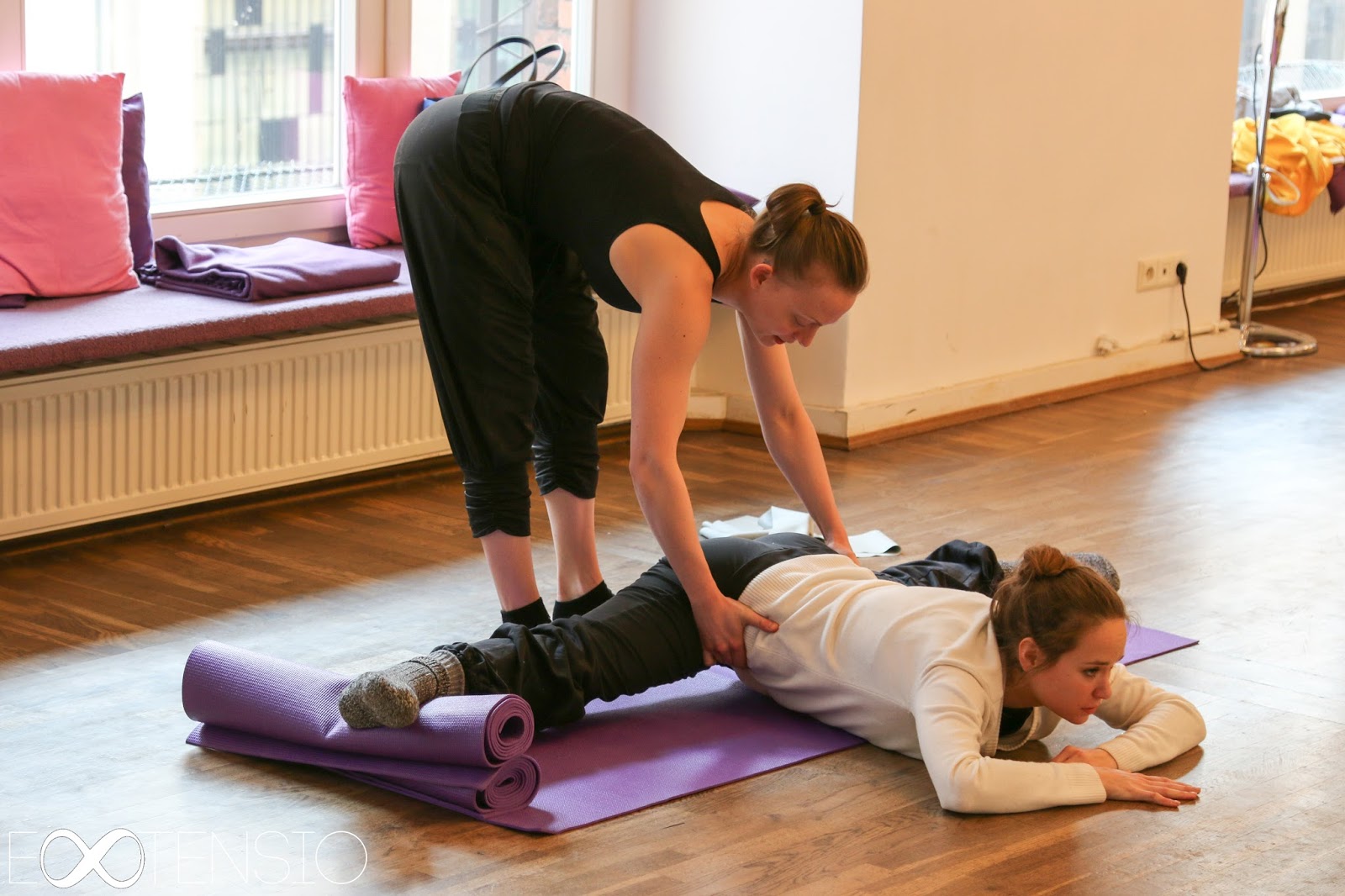
W momencie gdy osoba dociskana wykaże tendencje do wycofywania się - zacznie się wyrywać, zaciskać itp. - należy dociskanie, dociąganie natychmiast przerwać, ale nie raptownie. Następnie należy upewnić się, że wszystko jest w porządku i wspólnie dojść do decyzji czy kontynuujemy, czy przestajemy. Osoba dociskająca, czyli instruktor/trener nigdy nie powinna się sprzeciwiać woli osoby dociskanej, może jedynie umiejętnie przekonać, zasugerować co byłoby dobre lub wskazane dla osoby dociskanej/rozciąganej. 

3. Absolutnie nie wolno się forsować dociskania i niczego przyspieszać. 

Powyżej pisałam o tym, że to osoba dociskana musi podjąć decyzje o dociskaniu i to był jakoby aspektu psychiczny nie forsowania u kogoś dociskania. Istnieje rzecz jasna również aspekt fizyczny forsowania dociskania. Pod kątem fizycznym nie wolno przekraczać pewnych limitów w sposób narażający ciało na uraz. Pomoc w postaci dociskania musi odbywać się z wielkim wyczuciem oraz starannością i dbałością o odczucia osoby dociskanej. Odczucia mogą być na poziomie psychiki, jak i ciała. Nie należy zbyt mocno, zbyt szybko dociskać/rozciągać kogoś celem spełnienia swojej ambicji jako instruktora i chcieć udowodnić jakim to jest się świetnym (szybko działającym) instruktorem/trenerem. W stretchingu bowiem nic nie dzieje się szybko. Jak każdej materii tak i ciału należy okazać szacunek, cierpliwość i dać mu czas na przeanalizowanie zmian. U jednych ta analiza odbywa się na poziomie świadomym u jednych na podświadomym i zajmuje więcej lub mniej czasu, co nie zmienia faktu, że każdemu potrzebny jest czas. 

4. Nie ulegaj wpływom, nie forsuj siebie

Jako osoba chodząca na zajęcia typu stretching lub podobne musisz do siebie i tego, co widzisz, słyszysz podejść rozważnie oraz świadomie. Nie wszystko bowiem, co jest dobre dla innych musi być dobre dla Ciebie. Jedno to jest to co robi instruktor, drugie - co robią inne osoby się rozciągające, a trzecie - to co Ty czujesz i robisz względem siebie. Niestety jako ludzie mamy (każdy z nas) tendencję to robienia czegoś, bo ktoś inny to robi/zrobił. Co więcej mamy tendencje do nie analizowania tego, co robimy i nie brania pod uwagę ważnych czynników. W stretchingu to sprowadza się do tego, że mamy tendencję do zapominania o tym, że ktoś obok mógł ćwiczyć wiele lat więcej, mieć lepsze predyspozycje, mieć do czynienia z innymi formami aktywności fizycznej, które mogły pomóc w osiągnięciu lepszych rezultatów w krótszym czasie, itd. Przed podjęciem decyzji o tym, czy chce się być dociskanym należy zwyczajnie zastanowić się, czy jest się na to gotowym i odważnie słuchać siebie i tak samo odważnie mówić "tak" lub "nie"

Podsumowując: dociskanie - TAK, głupie dociskanie - NIE !!! Jak ze wszystkim - zanim się coś zrobi lub na coś się zgodzi należy pomyśleć.

MIŁEGO ROZCIĄGANIA !!!

///

ENGLISH VERSION


Legends are circulating all over the town about pressing/pushing down in stretching. It is said that this is very brutal, inhumane, that it hurts, and that it should absolutely be forbidden. You hear all the stories about people who have been injured during pressing/pushing down etc. And yes this is certain, like any kind of stretching, which is a physical activity - there is a high possibility of injury/or any trauma, so exactly the same thing might happen while stretching with pressing, a trainee who is being pressed/stretched – is definitely exposed to a high risk of tearing or straining muscles etc. Is the percentage of injuries caused by pressing versus incorrect and reckless stretching on one’s own higher? Frankly speaking I doubt it, and as a stretching trainer with huge experience in that field I have not heard of such situation, rather I have heard about large number of cases where injury was caused by lack of proper warm-up or too rapid physical activity without adequate and appropriate body preparation prior to stretching (sometimes lasting even up to several months).

I do not wish to defend people who call themselves instructors and they are not qualified and they take such a huge responsibility - conducting stretching classes without having proper and full knowledge of anatomy, physiology and the human psyche (‘How to find and get to know a good stretching instructor’ you can find out HERE), but I will strongly support physical contact – wise and balanced contact between the instructor and the student. Not only because I use this method, but also because I listen to my students and I know exactly what they say regarding their stretching workout and it is obvious that they do not refer to physiology, but only to their own feelings. Based on my experience, knowledge and careful listening to each body and direct communication between me and my trainees I consider a specific statement which is: ‘stretching with pressing one person by another is dangerous’ to be very misleading and confusing and simply untrue. As usual, it all depends on many factors, which I will try to describe these as transparently as I can. 


1. Choose wisely your stretching instructor / a person who will be pressing/pushing you down


As I have written in my earlier post about selectionand finding a good stretching instructor - it is not so easy to find a trustworthy person, properly trained and who would awake our confidence. Please note that so much depends on your stretching instructor - the condition of our body and psyche, achieving or not further progress and so much more. This is the person you entrust your body with assuming that the trainer knows what he or she is doing, and that he acts in compliance with the basic principles of ethics, the first rule is "DO NOT CAUSE ANY HARM". A person who will be pressing can only be:

  • a person we do not have an aversion to as this person will be in contact - cannot disgust us at any point,
  • thanks to whom we can calm down especially at a time when we reach the point of having a panic attack, which is very common during stretching sessions, and it is caused because the body is performing something extraordinary, which is often combined with a feeling of pain / and physical discomfort,
  • a person who inspires our trust and does not treat stretching just as fun,
  • who can respond to customized situation, which may be for instance: sudden getting out of the instructor’s hands, bursting into laughter, hitting an instructor (we as instructors often do not know what kind of reaction stretching might cause and there is a wide range of reactions a lot of possibilities),
  • who knows her/his body very well always broadens the knowledge of anatomy, physiology and the human psyche,
  • who is very well stretched, preferably with her/his own history of injuries caused by stretching – the best way to learn for everyone is to learn from their own mistakes and injuries teach us humility and prudence.
Sometimes we ask someone to help us, a random person or even someone who is close to us to press or to help us with any other activity related to our stretching workout without thinking about consequences of such a request. Never ever, (unless you are very experienced, you know your own body) should you ask for improper help, including asking a third party or someone who has no idea what it is all about. Also in many cases we are unable to explain what exactly the person asked is supposed to do for us – hat might be harmful.


2. The person who is pressed/pushed down should voluntarily agree to pressing

One of many principles of the human psyche functioning is a system of do's and don'ts. Every human being when it comes to an obligation or a prohibition of doing something has a tendency to rebel, and this causes different reactions in each body and it often comes down to increased muscle tension and being ready to fight or flight – that is in a nutshell. If you care for someone's safety you can order someone or forbid someone to do something, but there is a need to explain why and what for - then anyone will take a voluntary decision to obey the prohibition or the order. On the stretching ground: you must not push anyone by force and must not force someone to do what you want them to do, even when they do not want to do it or persuade. Pressing will only work when it is not an imperative, only when a person voluntarily surrenders to instructor’s hands. Only this way enables the body to achieve necessary ‘relaxation’ needed to continue pressing process.
At the time when a person pressed shows a tendency to pull away - tightens, etc. – pressing/pulling should be stopped immediately, but not abruptly. Then make sure that everything is well and make a mutual decision whether to continue or stop the training. An instructor should never oppose the will of a trainee, a good trainer can only skillfully convince or suggest what would be good or advisable for a student when pressing / or stretching.


3. Overstraining while pressing/pushing down is absolutely not allowed and do not accelerate anything.


As I have written above a person has to make a conscious decision about being pressed while stretching, it was a mental aspect – not to force oneself. For sure there is also a physical aspect of using too much force while pressing. From a physical point of view you must not exceed certain limits so the body is susceptible to injury. The help in the form of pressing must be done with great sensitivity, care and attention to feelings of a trainee. The perception might be at both levels the psyche and the body. Do not press too hard, or too fast in order to satisfy your own instructor’s ambitions and a need to prove that you are such a great (fast-acting) trainer. Nothing comes quickly in stretching. You should respect the body you work with as well as every other matter, be patient and give sufficient amount of time to analyze all the changes happening. For some such analysis is a conscious process for the others it might be subconscious and takes more or less time – very individual process, it does not change the fact that everyone needs time. 


4. Do not be affected by many external factors, do not overstrain yourself


As a person taking part in stretching classes or similar type of a workout you should be prudential and conscious when it comes to what you see or hear. Not everything what might be good for the others must be good for you. One thing is what instructor does/says, the second thing is what the others do while stretching session, and the third thing is what you feel. Unfortunately, as human beings we (all of us) have a tendency to do something because someone else does that / or did. There is more to that, we tend not to analyze what we do and do not take into account important factors. In stretching it comes down to the fact that we have an ability to forget that someone else could have trained much longer than we do, or a person next to us is much more experienced or simply her/his ability to stretch is much more developed than ours, or he/she has dealt with other forms of physical activity, which helped to achieve better results in shorter period of time, etc. Before making such a decision whether you want to be pressed you should simply ask yourself if you are ready for it and listen to what you feel carefully without any fear and have courage to say ‘yes’ or ‘no’, it is simple as that.

In conclusion, pressing - YES, reckless pressing - NO !!! As with everything else - before you do or agree to something, please stop and think.


ENJOY YOUR STRETCHING !!!

sobota, 28 września 2013

Stretching - animal instinct

(Polish version HERE)

Animals unlike humen don't lose theirs absolute atavistic impulses arising from biological needs , and simply follow the satisfaction of the basic needs of the body mostly , if not only , but I am not going to write about emotional life of animals :)

Animals , of course, do not wonder why they do something , they just do it : they are hungry - eat , dirty - wash themselves , they feel uncomfortable in their body - stretch . People, though so aware of the reality around us , but in many cases we are completely unaware of ourselves, our reactions , our needs, etc. And I wonder why it would be so complicated and why adding unnecessary philosophy ? The body gives the impulse , the impulse goes to brain and brain translates into language comprehensible to us and then there is reaction to it ( of course I am writing about about a healthy people ) . This is a very logical and simple matter – I feel uncomfotable in my body - I stretch , I feel too fat – I lose weight. By not satisfying the needs I actually make dekmage on myself , because I still feel bad and transfer my bad mood onto other. That is how really silly dissatisfaction of body neds is growing into a problem affecting other and complicating life even more. 

Our needs , although maybe a little different from the animals needs, but not much, are also biologically conditioned . Well, here comes this tiny, little difference , because our needs are also conditioned mentally . It is this subtle difference which affects the decision-making process and makes it more complex in humans than animals. It is our psyche that makes us instead of just doing something – think, think, think and finally instead of doing something people strat nad stop on thinking only and adding to normal activities a solid philosophy. And what I would advise in cases involving the body discomfort resulting from the lack of acceptance of one's body ot its current physical condition? - let us sometimes be just like our four-legged friends and let us learn from them. Animals eat when they need to , run when need , etc. Has anyone ever seen a wild animal with overweight or unable to move because of muscles ork failling due to the fact of not stretching them? No. And what does this tell us ? That sometimes, our psyche is fatal and when it comes to body issues its better tou use instincts.

What is has to do with stretching? Animals "invented" a great way to stretch the spine, which they can not massage and they rather can't ask let's say anothey lion - "Hey, listen, can you massage me - I'll give you a leg for a zebra for it." People who are able to observe and take from nature, saw, how do animals stretch and the after complex thinking process, invented their own position, which, though for us is less natural than for animals yet it is very effective and blissfully affecting many parts of the body .


Position of the triangle / dog with his head down ( check out the photo) - has a positive effect on many points in the body :

A ) strengthens the wrists
B ) stretches the shoulder girdle
C) stretches the lumbar spine
D) stretches the gluteus, pelvis and thigh muscles
E) stretches the tendons behind the knees and clf muscles
F ) stretches and strengthens the Achilles tendon

This position is largely supported by the pushing of hands from the floor , which really strengthens the back muscles and the shoulder girdle ( here we are dealing with isometric stretching , but I will write about isometric stretching other time ) .

So let us learn how simple instinct devoided of human psyche tells the animals what and how they should do certain things – regarding stretching of course . Let us oserve them and be isnpired by them and then figure out how to make it better and doable for people


ENJOY YOUR STRETCHING !!!